
原文地址:http://news.sciencenet.cn/htmlnews/2023/7/505756.shtm
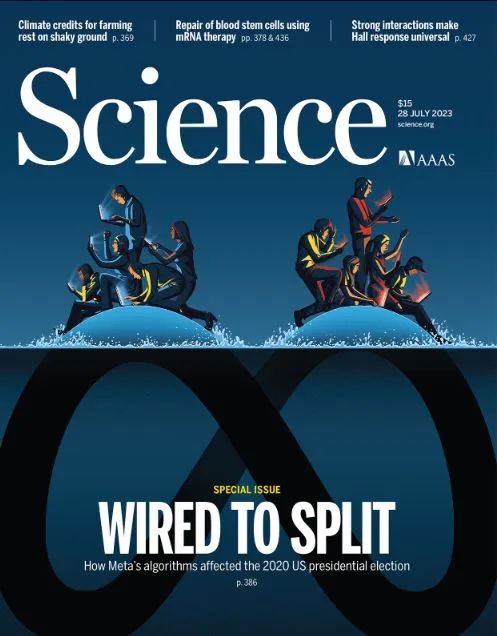
Science, 28 JUL 2023, Volume 381 Issue 6656
《科學》2022年7月28日,第381卷,6656期
物理學Physics
Observation of universal Hall response in strongly interacting Fermions
強相互作用費米子中普遍霍爾響應的觀測
作者:T.-W. ZHOU, G. CAPPELLINI et al.
鏈接:
https://www.science.org/doi/full/10.1126/science.add1969
摘要:
在這項研究中,我們使用了一個原子量子模擬器去追蹤超冷費米子在人工磁場纏繞雙線中的運動。通過可控淬火動力學,我們測量了一系列合成隧穿和原子相互作用強度的霍爾響應。
我們揭示了一個交互閾值之上的普遍的交互獨立行為,這與理論分析相一致。可以達到難以計算狀態證明了量子模擬在描述物質強相關拓撲狀態方面的能力。
Abstract:
HIn this work, we used an atomic quantum simulator in which we tracked the motion of ultracold fermions in two-leg ribbons threaded by artificial magnetic fields. Through controllable quench dynamics, we measured the Hall response for a range of synthetic tunneling and atomic interaction strengths. We unveil a universal interaction-independent behavior above an interaction threshold, in agreement with theoretical analyses. The ability to reach hard-to-compute regimes demonstrates the power of quantum simulation to describe strongly correlated topological states of matter.
Tensile cracks can shatter classical speed limits
拉伸裂紋可以打破傳統的速度限制
作者:MENG WANG, SONGLIN SHI et al.
鏈接:
https://www.science.org/doi/full/10.1126/science.adg7693
摘要:
脆性材料會因為快速開裂而失效。經典斷裂力學描述了拉伸裂紋的運動,它將釋放的彈性能耗散在裂紋尖端的點狀區域內。在這個框架內,“經典”拉伸裂紋不會超過瑞利波速。利用脆性新虎克材料,我們通過實驗證明了“超剪”(supershear)拉伸裂紋的存在,其速度超過剪切波速。
超剪裂紋可平穩加速超過波速,達到接近膨脹波的速度。控制超剪動力學的原理與指導“經典”裂紋的原理不同,這種斷裂模式在臨界施加應變時被激活。這種非經典的拉伸斷裂模式代表了我們對斷裂過程理解的根本轉變。
Abstract:
Brittle materials fail by means of rapid cracks. Classical fracture mechanics describes the motion of tensile cracks that dissipate released elastic energy within a point-like zone at their tips. Within this framework, a “classical” tensile crack cannot exceed the Rayleigh wave speed, cR. Using brittle neo-hookean materials, we experimentally demonstrate the existence of “supershear” tensile cracks that exceed shear wave speeds, cR. Supershear cracks smoothly accelerate beyond cR, to speeds that could approach dilatation wave speeds. Supershear dynamics are governed by different principles than those guiding “classical” cracks; this fracture mode is excited at critical (material dependent) applied strains. This nonclassical mode of tensile fracture represents a fundamental shift in our understanding of the fracture process.
語言學Linguistics
Language trees with sampled ancestors support a hybrid model for the origin of Indo-European languages
祖先樣本語言樹支持印歐語系起源的混合模型
作者:PAUL HEGGARTY, CORMAC ANDERSON et al.
鏈接:
https://www.science.org/doi/full/10.1126/science.abg0818
摘要:
印歐語系的起源一直備受爭議。核心詞匯的貝葉斯系統發育分析得出了相互矛盾的結果。有些人支持在距今9000年前從安納托利亞隨著農業擴展,另一些人則支持是在公元前6000年從東歐大草原隨著以馬為基礎的畜牧業傳播出去的觀點。
在此,我們提出了一個消除過去在同源編碼中不一致的、更廣泛的印歐核心詞匯數據庫。對該數據集的系統發育分析表明,極少有古代語言是現代進化枝的直系祖先,同時,我們得出該家族的根年齡約為8120年。雖然這個時間與草原假說不一致,但不排除高加索以南存在起源地,隨后其分支向北延伸到草原,之后擴散穿過歐洲。
我們將這種雜交假設與最近發表的來自草原和新月沃土北方的古代DNA證據進行了調和。
Abstract:
The origins of the Indo-European language family are hotly disputed. Bayesian phylogenetic analyses of core vocabulary have produced conflicting results, with some supporting a farming expansion out of Anatolia ~9000 years before present (yr B.P.), while others support a spread with horse-based pastoralism out of the Pontic-Caspian Steppe ~6000 yr B.P. Here we present an extensive database of Indo-European core vocabulary that eliminates past inconsistencies in cognate coding. Ancestry-enabled phylogenetic analysis of this dataset indicates that few ancient languages are direct ancestors of modern clades and produces a root age of ~8120 yr B.P. for the family. Although this date is not consistent with the Steppe hypothesis, it does not rule out an initial homeland south of the Caucasus, with a subsequent branch northward onto the steppe and then across Europe. We reconcile this hybrid hypothesis with recently published ancient DNA evidence from the steppe and the northern Fertile Crescent.
From language development to language evolution: A unified view of human lexical creativity
從語言發展到語言進化:人類詞匯創造的統一視角
作者:THOMAS BROCHHAGEN, GEMMA BOLEDA et al.
鏈接:
https://www.science.org/doi/full/10.1126/science.ade7981
摘要:
人類語言的一個特征是能通過詞義引申來表達多重意義這一創造性用法。這種詞匯創造性表現在不同的時間尺度上,從兒童時期的語言發展到詞義的歷史演變。我們探討了詞匯創造力的不同表現形式是否存在一個共同基礎。
使用計算模型,我們展示了一組簡約的語義知識類型,這些類型表征了跨越1400多種語言的發展數據以及意義擴展的進化產物。
進化數據模型很好地解釋了發育數據,反之亦然。這些發現表明,人類詞匯創造力有一個統一的基礎,同時存在于個體的短暫產物和跨語言系統發生的進化產物中。
Abstract:
A defining property of human language is the creative use of words to express multiple meanings through word meaning extension. Such lexical creativity is manifested at different timescales, ranging from language development in children to the evolution of word meanings over history. We explored whether different manifestations of lexical creativity build on a common foundation. Using computational models, we show that a parsimonious set of semantic knowledge types characterize developmental data as well as evolutionary products of meaning extension spanning over 1400 languages. Models for evolutionary data account very well for developmental data, and vice versa. These findings suggest a unified foundation for human lexical creativity underlying both the fleeting products of individual ontogeny and the evolutionary products of phylogeny across languages.
生物學Biology
Deploying synthetic coevolution and machine learning to engineer protein-protein interactions
利用合成協同進化和機器學習設計蛋白質-蛋白質相互作用
作者:AERIN YANG, KEVIN M. JUDE et al.
鏈接:
https://www.science.org/doi/full/10.1126/science.adh1720
摘要:
蛋白質-蛋白質相互作用的微調通過協同進化而自然發生,但這一過程很難在實驗室中重現。我們描述了一個合成蛋白質-蛋白質協同進化的平臺,可以從復合體庫中分離出相互作用的匹配對的突變蛋白。
這個共同進化復合物的大型數據集推動了對Z結構域-粘附體對之間的分子識別的系統級分析,涵蓋了廣泛的結構、親和性、交叉反應性和正交性,并捕獲了廣泛的共同進化網絡。此外,我們利用預訓練的蛋白質語言模型來擴大我們的協同進化屏幕的氨基酸多樣性,據預測重塑的界面將超出實驗庫范圍。
Abstract:
Fine-tuning of protein-protein interactions occurs naturally through coevolution, but this process is difficult to recapitulate in the laboratory. We describe a platform for synthetic protein-protein coevolution that can isolate matched pairs of interacting muteins from complex libraries. This large dataset of coevolved complexes drove a systems-level analysis of molecular recognition between Z domain–affibody pairs spanning a wide range of structures, affinities, cross-reactivities, and orthogonalities, and captured a broad spectrum of coevolutionary networks. Furthermore, we harnessed pretrained protein language models to expand, in silico, the amino acid diversity of our coevolution screen, predicting remodeled interfaces beyond the reach of the experimental library.
TRIM11 protects against tauopathies and is down-regulated in Alzheimer’s disease
TRIM11可以防止tau蛋白病變,并在阿爾茨海默病患者的大腦中顯示下調
作者:ZI-YANG ZHANG, DILSHAN S. HARISCHANDRA et al.
鏈接:
https://www.science.org/doi/full/10.1126/science.add6696
摘要:
在這里,通過系統地分析人類TRIMs蛋白,我們發現了一些TRIMs可以有效地抑制tau蛋白聚集。其中TRIM11在阿爾茨海默病患者的大腦中顯著下調。TRIM11促進突變型tau蛋白和多余的正常tau蛋白的蛋白酶體降解。它還通過作為分子伴侶來防止tau蛋白錯誤折疊,和分解酶來溶解預先形成的tau蛋白原纖維以增強其溶解性。
TRIM11維持神經元的連通性和活力。在多種tau蛋白病動物模型中,通過腺相關病毒顱內遞送TRIM11可改善病理、神經炎癥和認知障礙。這些結果表明,TRIM11下調有助于tau蛋白病的發病機制,恢復TRIM11的表達可能是一種有效的治療策略。
Abstract:
原文地址:http://news.sciencenet.cn/htmlnews/2024/3/518337.shtmScience,1MAR2024,VOL383,ISSUE6686《科學》2024年......
原文地址:http://news.sciencenet.cn/htmlnews/2024/2/517944.shtm編譯|馮維維Science,Volume383,Issue6685,23Februa......
原文地址:http://news.sciencenet.cn/htmlnews/2023/12/513970.shtmScience,8DEC2023,VOL382,ISSUE6675《科學》2023......
原文地址:http://news.sciencenet.cn/htmlnews/2023/10/510717.shtm編譯|李言Science, 20OCT2023,Volume......
原文地址:http://news.sciencenet.cn/htmlnews/2023/7/505756.shtmScience,28JUL2023,Volume381Issue6656《科學》20......