
編譯|李言
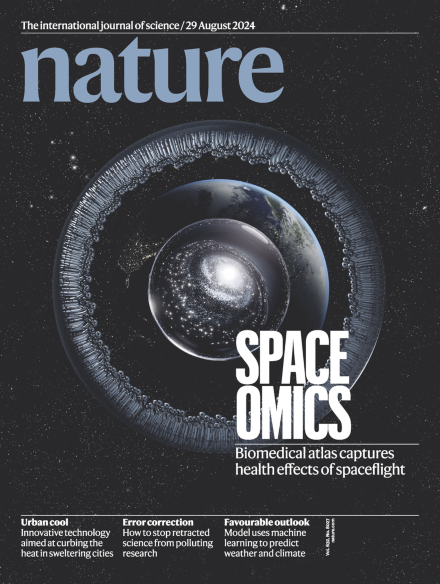
Nature, 29 August 2024, Volume 632 Issue 8027
《自然》2024年8月29日,第632卷,8027期
地球科學Earth Science
Earth’s ambipolar electrostatic field and its role in ion escape to space
地球的雙極靜電場及其在離子逃逸到太空中扮演的角色
▲ 作者:Glyn A. Collinson, Alex Glocer et al.
▲ 鏈接:https://www.nature.com/articles/s41586-024-07480-3
▲摘要:
在此,我們報告在250千米至768千米范圍內,僅由電離層電子向外壓力產生的行星靜電場(E∥⊕=1.09±0.17μVm?1)存在+0.55±0.09V的電位降。我們的實驗表明,地球的雙極靜電場控制著極地電離層的結構,將范圍高度提升至271%。
我們認為這將使冷O+離子向磁層的供應增加了3800%以上,其中波粒相互作用等其他機制可以加熱并進一步加速它們達到逃逸速度。地球的靜電場足夠強大到驅動極地風,并且可能是主導大部分磁層的冷氫離子群的起源。
▲ Abstract:
Here we report the existence of a +0.55?±?0.09?V electric potential drop between 250?km and 768?km from a planetary electrostatic field (E∥⊕?=?1.09?±?0.17?μV?m?1) generated exclusively by the outward pressure of ionospheric electrons. We experimentally demonstrate that the ambipolar field of Earth controls the structure of the polar ionosphere, boosting the scale height by 271%. We infer that this increases the supply of cold O+ ions to the magnetosphere by more than 3,800%, in which other mechanisms such as wave–particle interactions can heat and further accelerate them to escape velocity. The electrostatic field of Earth is strong enough by itself to drive the polar wind and is probably the origin of the cold H+ ion population1 that dominates much of the magnetosphere.
天文學Astronomy
A nebular origin for the persistent radio emission of fast radio bursts
快速射電暴持續射電發射的星云起源
▲ 作者:Gabriele Bruni, Luigi Piro et al.
▲ 鏈接:https://www.nature.com/articles/s41586-024-07782-6
▲ 摘要:
在此,我們報告在距離413Mpc的重復快速射電暴源FRB20201124A相關的第三個亮度較低的持續射電源的檢測,這大大擴展了預測關系到低亮度—低法拉第旋轉測量范圍(<1000?rad?m?2)。
在較低的法拉第旋轉測量值下,預期的射電光度低于當今射電望遠鏡的探測極限。這些發現支持了這樣一種觀點,即到目前為止觀測到的持續射電源是由快速射電暴環境中的星云產生的,并且由于較弱的磁離子介質,具有低法拉第旋轉測量的快速射電暴可能不會顯示出持續射電源。
這與將年輕的磁星作為快速射電暴中心引擎的模型基本一致。在該模型中,周圍的電離星云或雙星系統中的相互作用激波為持續的射電源提供動力。
▲ Abstract:
Here we report the detection of a third, less luminous persistent radio source associated with the repeating FRB source FRB?20201124A at a distance of 413?Mpc, substantially expanding the predicted relation into the low luminosity–low Faraday rotation measure regime (<1,000?rad?m?2). At lower values of the Faraday rotation measure, the expected radio luminosity falls below the limit-of-detection threshold for present-day radio telescopes. These findings support the idea that the persistent radio sources observed so far are generated by a nebula in the FRB environment and that FRBs with low Faraday rotation measure may not show a persistent radio source because of a weaker magneto-ionic medium. This is generally consistent with models invoking a young magnetar as the central engine of the FRB, in which the surrounding ionized nebula—or the interacting shock in a binary system—powers the persistent radio source.
工程學Engineering
Passive wing deployment and retraction in beetles and flapping microrobots
甲蟲和撲翼微型機器人翅膀的被動展開和收攏
▲ 作者:Hoang-Vu Phan, Hoon Cheol Park & Dario Floreano
▲ 鏈接:https://www.nature.com/articles/s41586-024-07755-9
▲摘要:
在此,我們展示了犀金龜可以毫不費力地展開它們的后翅,而不需要肌肉活動。我們展示了打開鞘翅會將像彈簧一樣的后翅部分從身體上釋放出來,從而為隨后的拍打動作提供所需的空間,從而使后翅進入飛行位置。
飛行結束后,犀金龜可以利用鞘翅推動后翅回到靜止位置,進一步支持了被動展開的假設。我們用一個能被動展開翅膀進行穩定可控飛行、并在著陸時整齊地收回翅膀的撲翼微型機器人驗證了這一假設,展示了一種簡單而有效的設計類昆蟲飛行微型機器的方法。
▲ Abstract:
Here we demonstrate that rhinoceros beetles can effortlessly deploy their hindwings without necessitating muscular activity. We show that opening the elytra triggers a spring-like partial release of the hindwings from the body, allowing the clearance needed for the subsequent flapping motion that brings the hindwings into the flight position. After flight, the beetle can use the elytra to push the hindwings back into the resting position, further strengthening the hypothesis of passive deployment. We validated the hypothesis using a flapping microrobot that passively deployed its wings for stable, controlled flight and retracted them neatly upon landing, demonstrating a simple, yet effective, approach to the design of insect-like flying micromachines.
化學Chemistry
Methyl-reducing methanogenesis by a thermophilic culture of Korarchaeia
高麗菌嗜熱培養的甲基還原甲烷生成
▲ 作者:Viola Krukenberg, Anthony J. Kohtz, Zackary J. Jay & Roland Hatzenpichler
▲ 鏈接:https://www.nature.com/articles/s41586-024-07829-8
▲ 摘要:
在此,我們展示了熱變形門(TACK超門)中Korarchaeia譜系成員的產甲烷生長。通過對washburnenis候選甲烷脫硫菌LCB3的富集培養,我們對代謝活性和同位素示蹤劑轉化進行了測量,以證明以氫為電子供體的甲醇還原為甲烷。
對古菌環基因組和轉錄組的分析揭示了與甲烷生成相關的能量守恒途徑的獨特修飾,包括參與氫和硫代謝的酶復合物。這一新的古細菌群的培養和鑒定對于更深入地評估產甲烷菌的多樣性、生理和生物化學至關重要。
▲ Abstract:
Here we show methanogenic growth by a member of the lineage Korarchaeia within the phylum Thermoproteota (TACK superphylum). Following enrichment cultivation of ‘Candidatus Methanodesulfokora washburnenis’ strain LCB3, we used measurements of metabolic activity and isotope tracer conversion to demonstrate methanol reduction to methane using hydrogen as an electron donor. Analysis of the archaeon’s circular genome and transcriptome revealed unique modifications in the energy conservation pathways linked to methanogenesis, including enzyme complexes involved in hydrogen and sulfur metabolism. The cultivation and characterization of this new group of archaea is critical for a deeper evaluation of the diversity, physiology and biochemistry of methanogens.
生物學Biology
The Space Omics and Medical Atlas (SOMA) and international astronaut biobank
空間組學和醫學圖譜(SOMA)與國際宇航員生物庫
▲ 作者:Eliah G. Overbey, JangKeun Kim et al.
▲ 鏈接:https://www.nature.com/articles/s41586-024-07639-y
▲ 摘要:
在此,我們介紹了空間組學和醫學圖譜(SOMA)。這是一個集成的數據和樣本存儲庫,包含來自不同任務的臨床、細胞和多組學研究資料,包括NASA雙胞胎研究、JAXA CFE研究、SpaceX靈感4號機組以及Axiom和Polaris。SOMA資源代表了公開可用的人類空間組學數據增加了10倍以上,康奈爾航空航天醫學生物庫提供了匹配的樣本。
該圖譜包括廣泛的分子和生理圖譜,包括基因組學、表觀基因組學、轉錄組學、蛋白質組學、代謝組學和微生物組數據集,揭示了跨任務的一些一致特征,包括細胞因子轉移、端粒延伸和基因表達變化,以及任務特異性分子反應和與同源、組織特異性小鼠數據集的鏈接。
▲ Abstract:
Here we present the Space Omics and Medical Atlas (SOMA), an integrated data and sample repository for clinical, cellular and multi-omic research profiles from a diverse range of missions, including the NASA Twins Study, JAXA CFE study, SpaceX Inspiration4 crew, Axiom and Polaris. The SOMA resource represents a more than tenfold increase in publicly available human space omics data, with matched samples available from the Cornell Aerospace Medicine Biobank. The Atlas includes extensive molecular and physiological profiles encompassing genomics, epigenomics, transcriptomics, proteomics, metabolomics and microbiome datasets, which reveal some consistent features across missions, including cytokine shifts, telomere elongation and gene expression changes, as well as mission-specific molecular responses and links to orthologous, tissue-specific mouse datasets.
Molecular and physiological changes in the SpaceX Inspiration4 civilian crewSpaceX Inspiration4
民用機組人員的分子和生理變化
▲ 作者:Christopher W. Jones, Eliah G. Overbey et al.
▲ 鏈接:https://www.nature.com/articles/s41586-024-07648-x
▲摘要:
在此,我們報告了針對為期3天太空飛行任務的主要發現。該任務引起了廣泛的生理和應激反應、以眼球錯位為指標的神經前庭變化,以及神經認知功能的改變,其中一些與長期太空飛行相匹配,但幾乎所有這些與返回地球后的基線(飛行前)沒有差異。
總體而言,這些初步民用航天數據表明,短期飛行任務不會造成重大健康風險,而且在解剖、細胞、生理和認知水平上測量人體對航天的最早適應階段提供了豐富的機會。最后,這些方法和結果為建立一個開放的、快速擴展的宇航員生物醫學數據庫奠定了基礎,該數據庫可以為私人和政府資助的太空任務提供對策開發信息。
▲ Abstract:
Here we report the primary findings from the 3-day spaceflight mission, which induced a broad range of physiological and stress responses, neurovestibular changes indexed by ocular misalignment, and altered neurocognitive functioning, some of which match those of long-term spaceflight, but almost all of which did not differ from baseline (pre-flight) after return to Earth. Overall, these preliminary civilian spaceflight data suggest that short-duration missions do not pose a significant health risk, and moreover present a rich opportunity to measure the earliest phases of adaptation to spaceflight in the human body at anatomical, cellular, physiological and cognitive levels. Finally, these methods and results lay the foundation for an open, rapidly expanding biomedical database for astronauts, which can inform countermeasure development for both private and government-sponsored space missions.
編譯|未玖Nature,5December2024,Volume636,Issue8041《自然》2024年12月5日,第636卷,8041期天文學AstronomyInsituspheroidfor......
編譯|馮維維Science, VOLUME385,ISSUE6715,20SEP2024《科學》第385卷,6715期,2024年9月20日物理學PhysicsSqueezingthequa......
編譯|李言Nature,19September2024,Volume633Issue8030《自然》,2024年9月19日,第633卷,8030期化學ChemistryGrowthofcomplete......
編譯|李言Science,6SEP2024,Volume385Issue6713《科學》2024年9月6日,第385卷,6713期物理學PhysicsAchievingopticaltranspare......
編譯|未玖Nature, 5September2024,Volume633,Issue8028《自然》2024年9月5日,第633卷,8028期天文學AstronomyGravitation......
編譯|李言Nature,29August2024,Volume632Issue8027《自然》2024年8月29日,第632卷,8027期地球科學EarthScienceEarth’sambipola......
編譯|馮維維Science,VOLUME385,ISSUE6709,9AUG2024《科學》,第385卷,6709期,2024年8月9日生命科學LifeScience Engineeredd......
編譯|李言Science,26JUL2024,Volume385Issue6707《科學》2024年7月26日,第385卷,6707期量子計算QuantumComputingOperatingsemi......
編譯|未玖Nature, 25July2024,VOL631,ISSUE8022《自然》2024年7月25日,第631卷,8022期材料科學MaterialsSciencePlasticit......
Nature,18July2024,Volume631Issue8021《自然》2024年7月18日,第631卷,8021期材料科學MaterialsScienceElectronholography......