
編譯 | 未玖
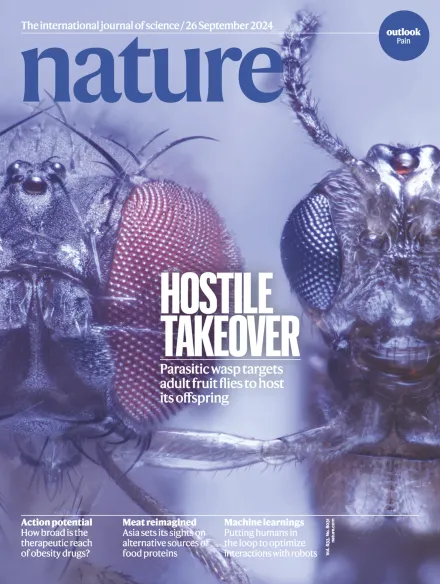
Nature, 26 September 2024, Volume 633, Issue 8031
《自然》,2024年9月26日,第633卷,8031期
天文學Astronomy
A temperate super-Jupiter imaged with JWST in the mid-infrared
JWST在中紅外波段成像的溫和超級木星圖像
▲ 作者:E. C. Matthews, A. L. Carter, P. Pathak, C. V. Morley, M. W. Phillips, S. Krishanth P. M., et al.
▲鏈接:
https://www.nature.com/articles/s41586-024-07837-8
▲摘要:
迄今為止,大約25顆直接成像的行星的年齡都小于500 Myr。除6顆外,其他行星的年齡都小于100 Myr。Eps Ind A(HD209100,HIP108870)是一顆K5V型恒星,與太陽年齡(最近推算為3.7-5.7 Gyr和3.5+0.8-1.3 Gyr)大致相當。長期的徑向速度趨勢和天體測量加速度導致了一顆巨大行星圍繞附近恒星(3.6384±0.0013 pc)運行的假說。
研究組報道了日冕圖像,揭示了一顆巨大的系外行星。它與這些徑向和天體測量結果一致,但與先前聲稱的行星特性不一致。這顆新行星的溫度約為275K,在10.65和15.50μm處非常明亮。但在3.5~5.0μm之間未檢測到,暗示大氣中存在未知的不透明源,或表明這是一顆金屬豐度高、碳氧比高的行星。
行星的最佳擬合溫度與理論熱演化模型一致,這些模型在該溫度范圍內未經測試。上述數據表明,這可能是該系統中唯一的巨行星,因此將其稱為b,盡管其軌道特性與之前聲稱的行星b有很大不同。
▲ Abstract:
Of the approximately 25 directly imaged planets to date, all are younger than 500 Myr, and all but six are younger than 100 Myr. Eps Ind A (HD209100, HIP108870) is a K5V star of roughly solar age (recently derived as 3.7–5.7 Gyr and 3.5+0.8-1.3 Gyr). A long-term radial-velocity trend and an astrometric acceleration led to claims of a giant planet orbiting the nearby star (3.6384 ± 0.0013 pc). Here we report JWST coronagraphic images which reveal a giant exoplanet that is consistent with these radial and astrometric measurements but inconsistent with the previously claimed planet properties. The new planet has a temperature of approximately 275 K and is remarkably bright at 10.65 and 15.50 μm. Non-detections between 3.5 and 5.0 μm indicate an unknown opacity source in the atmosphere, possibly suggesting a high-metallicity, high carbon-to-oxygen ratio planet. The best-fitting temperature of the planet is consistent with theoretical thermal evolution models, which were previously untested at this temperature range. The data indicate that this is probably the only giant planet in the system, and therefore we refer to it as b, despite it having significantly different orbital properties than the previously claimed planet b.
物理學Physics
Axon-like active signal transmission
軸突樣有源信號傳輸
▲ 作者:Timothy D. Brown, Alan Zhang, Frederick U. Nitta, Elliot D. Grant, Jenny L. Chong, Jacklyn Zhu, et al.
▲鏈接:
https://www.nature.com/articles/s41586-024-07921-z
▲摘要:
由于金屬的天然電阻,在金屬導體中傳播的任何電信號都會失去振幅。要補償這種損耗,目前需要反復斷開導體,并插入吸收和再生信號的放大器。這種持續百年的原始策略嚴重限制了現代互連密集芯片的設計和性能。
研究組提出了一種基于半穩定混沌邊緣(EOC)的迥然不同的原始技術,這是一種長期理論化但實驗難以捉摸的機制,也是生物軸突中主動(自放大)傳輸的基礎。通過電進入LaCoO3中的自旋交叉,研究組分離出半穩定的EOC,其特征是小信號負電阻和擾動放大。在EOC偏置介質頂部的金屬線中,一端的信號輸入在另一端離開后放大,而不通過單獨的放大組件。
雖然表面上類似于超導,有源傳輸在常溫常壓下提供可控放大的時變小信號傳播,但需要帶電的EOC介質。動態原位熱譜揭示了EOC介質的放大—偏置能量機制,部分用于放大金屬線中的信號,而不是完全作為熱量耗散,從而實現空間連續有源傳輸,這有望改變復雜電子芯片的設計和性能。
▲ Abstract:
Any electrical signal propagating in a metallic conductor loses amplitude due to the natural resistance of the metal. Compensating for such losses presently requires repeatedly breaking the conductor and interposing amplifiers that consume and regenerate the signal. This century-old primitive severely constrains the design and performance of modern interconnect-dense chips. Here we present a fundamentally different primitive based on semi-stable edge of chaos (EOC), a long-theorized but experimentally elusive regime that underlies active (self-amplifying) transmission in biological axons. By electrically accessing the spin crossover in LaCoO3, we isolate semi-stable EOC, characterized by small-signal negative resistance and amplification of perturbations. In a metallic line atop a medium biased at EOC, a signal input at one end exits the other end amplified, without passing through a separate amplifying component. While superficially resembling superconductivity, active transmission offers controllably amplified time-varying small-signal propagation at normal temperature and pressure, but requires an electrically energized EOC medium. Operando thermal mapping reveals the mechanism of amplification—bias energy of the EOC medium, instead of fully dissipating as heat, is partly used to amplify signals in the metallic line, thereby enabling spatially continuous active transmission, which could transform the design and performance of complex electronic chips.
材料科學Materials Science
One step from oxides to sustainable bulk alloys
只需一步!從氧化物到可持續大塊合金
▲ 作者:Shaolou Wei, Yan Ma & Dierk Raabe
▲鏈接:
https://www.nature.com/articles/s41586-024-07932-w
▲摘要:
傳統的冶金生產包括三個步驟:從礦石中提取金屬,通過液體加工和熱機械加工將其混合成合金,以獲得所需的微觀結構。由于對可持續經濟的迫切需求,這種自青銅器時代就開始實行的順序方法至今已達極限:幾乎10%的溫室氣體排放歸因于使用化石還原劑和高溫冶金加工。
研究組提出了一種基于H2的氧化還原合成和壓塑方法,通過將金屬提取、合金化和熱機械加工合并到一個單一固態操作中,革新了傳統的合金制造策略。他們提出了一個熱力學指導原則和一個通用的動力學概念,以消除萃取冶金和物理冶金之間的經典界限,從而釋放出極大的可持續大塊合金設計機遇。
鐵—鎳因瓦塊體合金是最吸引人的鐵材料之一,但生產起來最“臟”:因瓦表現出獨特的低熱膨脹,實現了從精密儀器到低溫部件的關鍵應用。然而該工藝臭名昭著地不環保,生產每公斤鎳造成的二氧化碳排放量是鐵的10倍以上,使得這種合金類別成為完美的示范案例。
該可持續方法將氧化物直接轉化為塊體綠色合金,頗具應用價值,所有這些都在遠低于塊體熔點的溫度下獲得,同時保持零二氧化碳足跡。
▲ Abstract:
Metallurgical production traditionally involves three steps: extracting metals from ores, mixing them into alloys by liquid processing and thermomechanical processing to achieve the desired microstructures. This sequential approach, practised since the Bronze Age, reaches its limit today because of the urgent demand for a sustainable economy: almost 10% of all greenhouse gas emissions are because of the use of fossil reductants and high-temperature metallurgical processing. Here we present a H2-based redox synthesis and compaction approach that reforms traditional alloy-making by merging metal extraction, alloying and thermomechanical processing into one single solid-state operation. We propose a thermodynamically informed guideline and a general kinetic conception to dissolve the classical boundaries between extractive and physical metallurgy, unlocking tremendous sustainable bulk alloy design opportunities. We exemplify this approach for the case of Fe–Ni invar bulk alloys, one of the most appealing ferrous materials but the dirtiest to produce: invar shows uniquely low thermal expansion, enabling key applications spanning from precision instruments to cryogenic components. Yet, it is notoriously eco-unfriendly, with Ni causing more than 10 times higher CO2 emission than Fe per kilogram production, qualifying this alloy class as a perfect demonstrator case. Our sustainable method turns oxides directly into green alloys in bulk forms, with application-worthy properties, all obtained at temperatures far below the bulk melting point, while maintaining a zero CO2 footprint.
能源科學Energy Science
Micronuclear battery based on a coalescent energy transducer
基于聚能傳感器的微核電池
▲ 作者:Kai Li, Congchong Yan, Junren Wang, Kun Zhu, Junjun Guo, Yugang Zhang, et al.
▲鏈接:
https://www.nature.com/articles/s41586-024-07933-9
▲摘要:
微核電池利用放射性同位素的放射性衰變產生的能量進行小規模發電,通常在納瓦或微瓦范圍內。與化學電池不同,微核電池的壽命與所用放射性同位素的半衰期有關,其使用壽命可長達數十年。此外,放射性衰變不受溫度、壓力和磁場等環境因素的影響,這使得微核電池在傳統電池被證明不切實際或難以更換的情況下成為持久可靠的電源。
镅的常見放射性同位素(241Am和243Am)是α-衰變發射體,半衰期超過數百年。傳統微核電池結構中的嚴重自吸附阻礙了α-衰變能量的高效轉換,為α-放射性同位素微核電池的開發帶來了挑戰。
研究組提出了一種微核電池結構,其中包括一個通過將243Am摻入發光鑭系配位聚合物的聚能傳感器。這種方法將放射性同位素與分子水平上的能量傳感器耦合在一起,與傳統結構相比,從α衰變能量到持續自發光的能量轉換效率提高了8000倍。
當與將自發光轉化為電能的光伏電池結合使用時,研究組獲得了一種新型的放射性光伏微核電池,其總功率轉換效率為0.889%,單位活動功率為139 μW Ci-1。
▲ Abstract:
Micronuclear batteries harness energy from the radioactive decay of radioisotopes to generate electricity on a small scale, typically in the nanowatt or microwatt range. Contrary to chemical batteries, the longevity of a micronuclear battery is tied to the half-life of the used radioisotope, enabling operational lifetimes that can span several decades. Furthermore, the radioactive decay remains unaffected by environmental factors such as temperature, pressure and magnetic fields, making the micronuclear battery an enduring and reliable power source in scenarios in which conventional batteries prove impractical or challenging to replace. Common radioisotopes of americium (241Am and 243Am) are α-decay emitters with half-lives longer than hundreds of years. Severe self-adsorption in traditional architectures of micronuclear batteries impedes high-efficiency α-decay energy conversion, making the development of α-radioisotope micronuclear batteries challenging. Here we propose a micronuclear battery architecture that includes a coalescent energy transducer by incorporating 243Am into a luminescent lanthanide coordination polymer. This couples radioisotopes with energy transducers at the molecular level, resulting in an 8,000-fold enhancement in energy conversion efficiency from α decay energy to sustained autoluminescence compared with that of conventional architectures. When implemented in conjunction with a photovoltaic cell that translates autoluminescence into electricity, a new type of radiophotovoltaic micronuclear battery with a total power conversion efficiency of 0.889% and a power per activity of 139 microwatts per curie (μW Ci-1) is obtained.
地球科學Earth Science
Forest fire size amplifies postfire land surface warming
森林火災規模放大了火災后地表升溫
▲ 作者:Jie Zhao, Chao Yue, Jiaming Wang, Stijn Hantson, Xianli Wang, Binbin He, et al.
▲鏈接:
https://www.nature.com/articles/s41586-024-07918-8
▲摘要:
氣候變暖導致極端火災天氣普遍增加,使森林火災持續時間更長,規模更大。近幾十年來,加拿大、美國和澳大利亞的平均森林火災規模翻了一番甚至三倍。反過來,森林火災通過調節陸地—大氣中的碳、氮、氣溶膠、能量和水的通量來反饋氣候。然而,越來越大的火災對地表氣候的影響及其對土地管理的影響仍有待確定。
研究組利用衛星觀測表明,在北半球溫帶和北方森林中,火災規模持續放大了夏季每單位過火面積長達十年的火災后地表升溫。隨著闊葉樹豐度的增加,升溫及其隨火災規模的放大都減弱,這與闊葉樹種比針葉樹種更低的火災脆弱性相一致。
火災規模增強的升溫可能會影響火災后林分更新的成功和組成以及永久凍土退化,對未來氣候和火災動態表現出此前被忽視的額外反饋效應。鑒于北方森林火災規模預計會增加,氣候智能型林業應致力于減輕大火的氣候風險,或可通過適當增加闊葉樹的比例,并避免種植活躍的焦生植物。
▲ Abstract:
Climate warming has caused a widespread increase in extreme fire weather, making forest fires longer-lived and larger. The average forest fire size in Canada, the USA and Australia has doubled or even tripled in recent decades. In return, forest fires feed back to climate by modulating land–atmospheric carbon, nitrogen, aerosol, energy and water fluxes. However, the surface climate impacts of increasingly large fires and their implications for land management remain to be established. Here we use satellite observations to show that in temperate and boreal forests in the Northern Hemisphere, fire size persistently amplified decade-long postfire land surface warming in summer per unit burnt area. Both warming and its amplification with fire size were found to diminish with an increasing abundance of broadleaf trees, consistent with their lower fire vulnerability compared with coniferous species. Fire-size-enhanced warming may affect the success and composition of postfire stand regeneration as well as permafrost degradation, presenting previously overlooked, additional feedback effects to future climate and fire dynamics. Given the projected increase in fire size in northern forests, climate-smart forestry should aim to mitigate the climate risks of large fires, possibly by increasing the share of broadleaf trees, where appropriate, and avoiding active pyrophytes.
Carbon emissions from the 2023 Canadian wildfires
2023年加拿大野火的碳排放量
▲ 作者:Brendan Byrne, Junjie Liu, Kevin W. Bowman, Madeleine Pascolini-Campbell, Abhishek Chatterjee, Sudhanshu Pandey, et al.
▲鏈接:
https://www.nature.com/articles/s41586-024-07878-z
▲摘要:
2023年加拿大森林大火在規模和強度上都很極端,年平均燒毀面積是過去40年的7倍多。
研究組基于衛星一氧化碳觀測的反演模型,量化了2023年5月至9月這些火災的碳排放量。結果發現碳排放量的規模為647 TgC(570-727 TgC),與排放大國的年化石燃料排放量相當,僅次于印度、中國和美國。
研究組發現,大范圍的干熱天氣是火災蔓延的主要驅動因素,2023年是至少自1980年以來最溫暖、最干燥的一年。盡管2023年溫度相對于歷史記錄頗極端,但氣候預測表明,即使在溫和的氣候緩解情景下(共同社會經濟途徑,SSP 2-4.5),該溫度在2050年代也可能是典型的。
這種情況可能會導致火災活動增加,抑制加拿大森林的碳吸收,加劇人們對這些森林作為碳匯的長期持久性的擔憂。
▲ Abstract:
The 2023 Canadian forest fires have been extreme in scale and intensity with more than seven times the average annual area burned compared to the previous four decades. Here, we quantify the carbon emissions from these fires from May to September 2023 on the basis of inverse modelling of satellite carbon monoxide observations. We find that the magnitude of the carbon emissions is 647?TgC (570–727?TgC), comparable to the annual fossil fuel emissions of large nations, with only India, China and the USA releasing more carbon per year. We find that widespread hot–dry weather was a principal driver of fire spread, with 2023 being the warmest and driest year since at least 1980. Although temperatures were extreme relative to the historical record, climate projections indicate that these temperatures are likely to be typical during the 2050s, even under a moderate climate mitigation scenario (shared socioeconomic pathway, SSP?2–4.5). Such conditions are likely to drive increased fire activity and suppress carbon uptake by Canadian forests, adding to concerns about the long-term durability of these forests as a carbon sink.
近日,中國科學技術信息研究所發布《2025年中國科技論文統計報告》。報告數據顯示,我國熱點論文世界占比首次過半,達53.2%,世界排名持續保持第一位。高被引論文數同比增加3.6%,保持世界第二位。熱點......
一段時間以來,類似本科生已發表14篇SCI論文等荒誕事件頻繁進入公眾視野,暴露出學術界存在一定程度的急功近利、急于求成問題。學術浮躁之風背離科學精神,危害學術生態,必須狠剎!學術研究是復雜細致的腦力勞......
《自然》近日揭曉了21世紀被引用次數最多的25篇論文。令人意外的是,mRNA疫苗、CRISPR基因編輯、希格斯玻色子的發現等重大突破性成果均未進入榜單。真正入榜的,反而是涉及人工智能(AI)、提升研究......
最近,DeepSeek火爆出圈,人工智能熱度再上新高。在高校,學生們利用AI工具輔助論文寫作已越發普遍,相比翻閱厚重的書籍資料或者利用互聯網搜索引擎查找資料,借助AI工具讓論文撰寫方便了很多。但在調查......
本科生究竟要不要寫畢業論文?不久前,一則新聞再掀波瀾。寧波大學科學技術學院人文學院允許漢語言文學專業學生,以網文作品代替學位論文,從而獲得畢業資格。這讓不少網友覺得“不可思議”,紛紛質疑這一行為是“放......
本科生究竟要不要寫畢業論文?不久前,一則新聞再掀波瀾。寧波大學科學技術學院人文學院允許漢語言文學專業學生,以網文作品代替學位論文,從而獲得畢業資格。這讓不少網友覺得“不可思議”,紛紛質疑這一行為是“放......
文|《中國科學報》記者徐可瑩李思輝39歲的孫亞東不久前收獲了人生第4篇Science論文。第一作者兼通訊作者的標注,讓他的貢獻躍然紙上。進入不惑之年前,他扎實地立住了自己的科研人設。這也是他本人最喜歡......
編譯|未玖Nature,26September2024,Volume633,Issue8031《自然》,2024年9月26日,第633卷,8031期天文學AstronomyAtemperatesupe......
編譯|未玖Nature,26September2024,Volume633,Issue8031《自然》,2024年9月26日,第633卷,8031期天文學AstronomyAtemperatesupe......
文|《中國科學報》記者溫才妃“北京大學本碩博、教授、博士生導師。”“對學生的基礎知識和成績無要求。”“實驗無需長時間重復操作。”“若每周工作15小時以上,保證發表IF(影響因子)大于4的論文(一作/共......