
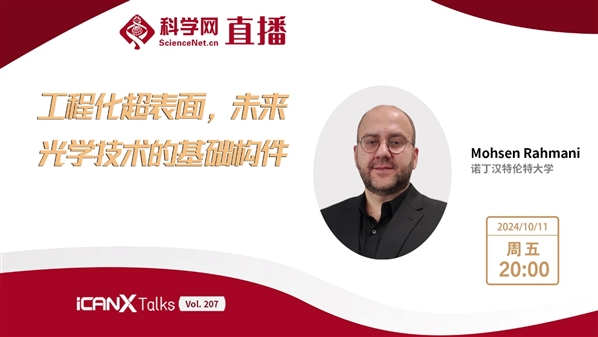
直播時間:2024年10月11日(周五)20:00-21:30
直播平臺:

科學網APP
https://weibo.com/l/wblive/p/show/1022:2321325088295842611355
(科學網微博直播間鏈接)

科學網微博

科學網視頻號
北京時間2024年10月11日晚八點,iCANX Talks 第207期邀請到了諾丁漢特倫特大學Mohsen Rahmani作為主講嘉賓,安大略理工大學Amirkianoosh Kiani,北海道大學Yoshito Y. Tanaka兩位教授也將進行分享!廈門大學Minghui Hong、北京大學Haixia Zhang兩位教授擔任研討嘉賓,澳大利亞國立大學 Lan Fu教授擔任主持人。
這將是一場匯聚頂尖學者的盛會,共同探討前沿科技與學術挑戰!更多精彩,敬請期待!
【嘉賓介紹】

Mohsen Rahmani
諾丁漢特倫特大學
Engineered meta-surfaces, building blocks of tomorrow’s optical technologies
【Abstract】
Recent advancements in nanofabrications, characterisations, and computer modelling have allowed the generation of arrays of engineered nanoparticles, called meta-surfaces, that extraordinarily control light characteristics. They can reproduce the functions of bulky geometrical optics such as lenses, mirrors or filters. Alongside that, occasionally, metasurfaces can offer some functionalities that are not achievable by geometrical Optics, such as tunability. Such advances have led to revolutionary applications in several fields, including but not limited to meta-lenses, polarisation converters, nano-sensors, and holograms. In this talk, I will briefly review the research activities of the Advanced Optics and Photonics Group at Nottingham Trent University on light-matter manipulation for real-life applications. I will discuss how engineering metallic, dielectric, and semiconductor nanoparticles enable us to control the light intensity, frequency, and propagation direction. I will demonstrate how such controls can help us to generate optical nano-switches with switching time faster than the human eye’s response. Also, I will explain how we can engineer nanoparticles to convert images from the near-infrared region, invisible to human eyes, to the visible region. Finally, I will show our latest results on how nanostructures can help monitor individual proteins over time. These are tiny examples, among many other technologies that are being developed in the community, of why many people consider photonics at the heart of cutting-edge technologies in the 21st century.
最近在納米制造、表征和計算機建模方面的進展,使得我們可以生成一種稱為超表面(meta-surfaces)的工程納米顆粒陣列,這些超表面能夠非凡地控制光的特性。它們能夠復制體積龐大幾何光學元件的功能,如透鏡、鏡子或濾光片。除此之外,有時超表面能夠提供一些幾何光學無法實現的功能,比如可調諧性。這些進展在包括但不限于超透鏡、偏振轉換器、納米傳感器和全息圖等多個領域帶來了革命性的應用。在本次演講中,我將簡要回顧諾丁漢特倫特大學高級光學與光子學組在光物質操控方面的研究活動,這些研究活動針對現實生活的應用。我將討論如何通過設計金屬、介質和半導體納米顆粒來控制光的強度、頻率和傳播方向。我將展示這種控制如何幫助我們生成比人眼反應時間更快的光學納米開關。此外,我還將解釋我們如何設計納米顆粒,將近紅外區域的圖像(肉眼不可見)轉換到可見區域。最后,我將展示我們在如何利用納米結構隨時間監測單個蛋白質方面的最新成果。這些只是眾多正在開發的技術中的一小部分例子,許多人認為光子學是21世紀尖端技術的核心。
【BIOGRAPHY】
Prof. Mohsen Rahmani is a professor of optics and photonics and the leader of the advanced optics and optics laboratory at Nottingham Trent University (NTU), in the UK. He obtained his PhD from the National University of Singapore in 2013, followed by a postdoc fellowship at Imperial College London and the Australian Research Council Early Career Fellowship at the Australian National University. In 2020, he joined NTU via the prestigious Royal Society Wolfson Fellowship. Shortly after moving to the UK, he was also awarded the UK Research and Innovation Future Leaders Fellowship. His research activities span over light-matter interactions with nanometre-scale particles for applications in flat optics, near-infrared imaging, bio-sensing, and reconfigurable optics. He has received several prestigious awards and prizes, including the Australian Eureka Prize (Australian Oscar of Science), the Early Career Medal from the International Union of Pure and Applied Physics, and the Australian Optical Society Geoff Opat Award. Professor Rahmani has delivered 40+ invited talks, seminars and keynotes at international conferences and has published more than 80 peer-reviewed journal papers (H-index=43). He is the past chair of the IEEE Nanotechnology Chapter across the UK and Ireland section and a distinguished lecturer for IEEE Nanotechnology Council 2024.
Mohsen Rahmani教授是英國諾丁漢特倫特大學(NTU)的光學與光子學教授,同時也是高級光學與光子學實驗室的負責人。他于2013年在新加坡國立大學獲得博士學位,隨后在倫敦帝國理工學院從事博士后研究,并在澳大利亞國立大學獲得澳大利亞研究理事會早期職業研究員獎學金。2020年,他通過享有盛譽的皇家學會沃爾夫森獎學金加入了NTU。移居英國后不久,他還被授予英國研究與創新未來領袖獎學金。他的研究活動涵蓋了與納米尺度顆粒的光物質相互作用,應用于平面光學、近紅外成像、生物傳感和可重構光學等領域。他獲得了許多著名獎項和獎金,包括澳大利亞尤里卡獎(澳大利亞科學奧斯卡)、國際純粹與應用物理聯合會早期職業獎章,以及澳大利亞光學學會Geoff Opat獎。Rahmani教授已在國際會議上發表了40多個邀請演講、研討會和主題報告,并發表了80多篇同行評審的期刊論文(H指數=43)。他是IEEE英國和愛爾蘭分會納米技術分會的前任主席,也是IEEE納米技術委員會2024年的杰出講師。

Amirkianoosh Kiani
安大略理工大學
Semiconductor Nanowires for Optoelectronics Applications
【ABSTRACT】
The Ultra-short Laser Pulse for In-situ Nanostructure Generation (ULPING) technique represents a significant advancement in the fabrication of nano energy materials for energy storage devices. This innovative method utilizes ultra-short laser pulses to create intricate 3D nanonetworks, enhancing the electrochemical performance and longevity of energy storage systems, including supercapacitors. By precisely controlling surface morphology and nanostructure formation, ULPING improves the efficiency and capacity of these devices, offering a versatile and effective approach to developing high-performance materials essential for next-generation energy solutions. This presentation will delve into the mechanisms and applications of ULPING, showcasing its potential to revolutionize the field of energy storage.
用于原位納米結構生成的超短激光脈沖(ULPING)技術在儲能設備的納米能源材料制造方面取得了重大進展。這種創新方法利用超短激光脈沖創建復雜的3D納米網絡,增強了包括超級電容器在內的儲能系統的電化學性能和壽命。通過精確控制表面形態和納米結構的形成,ULPING提高了這些設備的效率和容量,為開發下一代能源解決方案所必需的高性能材料提供了一種多功能且有效的方法。本次演講將深入探討ULPING的機制和應用,展示其在能源存儲領域革命化的潛力。
【BIOGRAPHY】
Dr. Amirkianoosh Kiani is an esteemed Associate Professor in the Department of Mechanical and Manufacturing Engineering at Ontario Tech University (ON, Canada), where he also serves as the Graduate Program Director. With a prolific career in advanced materials research, Dr. Kiani has made significant contributions to the fields of nano fabrication and laser materials processing.vOne of Dr. Kianis most notable achievements is the development of a novel technique known as Ultra-short Laser Pulse for In-situ Nanostructure Generation (ULPING). This groundbreaking method leverages ultra-short laser pulses to fabricate complex 3D nanonetworks and semiconductor materials, offering a versatile and efficient approach to materials synthesis. The ULPING technique stands out for its ability to create high-performance energy materials and electrode structures, which are crucial for various applications, including supercapacitors and other energy storage devices. Dr. Kiani’s research has demonstrated that the ULPING method can significantly enhance the electrochemical performance of materials by optimizing surface morphology and nanostructure formation. This innovation not only improves the efficiency and lifespan of energy storage systems but also opens new avenues for the fabrication of advanced 3D nanonetwork semiconductors. These semiconductors are pivotal in the development of next-generation electronic devices, biosensing technologies, and other high-tech applications. Dr. Kiani’s innovative research has been widely presented at international conferences and published in several reputable journals. His contributions to the scientific community have been recognized with funding from prestigious organizations such as the Ontario Centres of Excellence and the Natural Sciences and Engineering Research Council of Canada (NSERC). With a commitment to pushing the boundaries of materials science and engineering, Dr. Kiani continues to inspire and lead in the quest for more efficient, sustainable, and high-performing nanomaterials.
Amirkianoosh Kiani博士是加拿大安大略理工大學(ON,加拿大)機械與制造工程系的一位受人尊敬的副教授,同時他也擔任研究生項目主任。Kiani博士在先進材料研究領域有著豐富的職業生涯,在納米制造和激光材料加工領域做出了重要貢獻。Kiani博士最引人注目的成就之一是開發了一種名為用于原位納米結構生成的超短激光脈沖(ULPING)的新技術。這種開創性的方法利用超短激光脈沖制造復雜的3D納米網絡和半導體材料,為材料合成提供了一種多功能且高效的方法。ULPING技術以其能夠創建高性能能源材料和電極結構而脫穎而出,這對于包括超級電容器在內的各種應用至關重要。Kiani博士的研究表明,通過優化表面形態和納米結構的形成,ULPING方法可以顯著提高材料的電化學性能。這一創新不僅提高了儲能系統的效率和壽命,還為制造先進的3D納米網絡半導體開辟了新途徑。這些半導體在下一代電子設備、生物傳感技術和其他高科技應用的發展中起著關鍵作用。Kiani博士的創新研究已在國際會議上廣泛展示,并在多個知名期刊上發表。他對科學界的貢獻得到了安大略卓越中心和加拿大自然科學與工程研究理事會(NSERC)等知名組織的資助。Kiani博士致力于推動材料科學與工程的邊界,繼續在尋求更高效、可持續和高性能納米材料的道路上激勵和領導。

Yoshito Y. Tanaka
北海道大學
Light-Powered Nanoactuators: Controlling Light Momentum with Metallic Optical Nanoelements
【ABSTRACT】
Optical forces resulting from the momentum transfer of light in light-matter interactions are powerful tools for actuating micromachines and hold great potential for miniaturization and simplification of lab-on-a-chip systems. However, the conventional approaches using optical tweezers, which won the 2018 Nobel Prize in Physics, require focusing and steering of an incident laser beam with bulk optics to control the light momentum and optical force, resulting in a bottleneck in the integration and implementation of the optically actuated micromachines. In this presentation, I will describe nanoscale metallic optical elements such as nanolenses and nanomirrors, which control light momentum and optical force at the nanoscale. I will introduce how these optical nanoelements are designed and how they can be applied to nanoactuators and how they remove the limitation of light diffraction and the need for focusing and steering of the light beams. Finally, I will briefly discuss our ongoing study on how actuators based on the optical nanoelements can acquire autonomy.
光與物質相互作用中產生的光的動量轉移導致的光學力是驅動微電機的強大工具,對芯片實驗室系統的微型化和簡化具有巨大潛力。然而,傳統的光學鑷子方法,該方法贏得了2018年諾貝爾物理學獎,需要使用體積光學聚焦和操縱入射激光束以控制光動量和光學力,這在光學驅動微電機的集成和實施中造成了瓶頸。在本次演講中,我將描述納米尺度的金屬光學元件,如納米透鏡和納米鏡,它們在納米尺度上控制光動量和光學力。我將介紹這些光學納米元件是如何設計的,以及它們如何應用于納米執行器,以及它們如何消除光衍射的限制和對光束聚焦和操縱的需求。最后,我將簡要討論基于光學納米元件的執行器如何獲得自主性。
【BIOGRAPHY】
Dr. Yoshito Tanaka is a Professor in the Department of Photonics and Optical Science and Head of the Nanosystem Optical Manipulation Group at Research Institute for Electric Science, Hokkaido University, Japan. He received his Ph.D. from Osaka University in 2009 for his work on optical manipulations of nanoparticles such as J-aggregates, polymers, and metal nanoparticles using a focused laser beam (Optical Tweezers). Prior to his present position, which he has held since 2023, he started his career as a Postdoctoral Researcher at Hokkaido University (2009), held a prestigious research fellowship for young scientists by the Japan Society for the Promotion of Science (JSPS) at Imperial College London (2013) and worked as a Specially Assigned Assistant Professor at Kwansei Gakuin University (2014) and then an Assistant Professor at the University of Tokyo. He was also appointed as a PRESTO/JST researcher during 2015–2019. After his Ph.D., his has focused on understanding and controlling the interactions between artificial nanostructures and light from the viewpoint of light momentum and optical force, and has created novel optical nanomanipulations and nanoactuators that overcome the limitations and constraints of optical tweezers. In recognition of such original and unique research, he has received several prestigious awards, including the Young Scientist Award of the Minister of Education, Culture, Sports, Science and Technology in 2018, the Japan Laser Society Award in 2020, and the Optical Paper Award in 2021.
Yoshito Tanaka博士是日本北海道大學光子學與光學科學系教授,納米系統光學操縱研究小組負責人。他于2009年在大阪大學獲得博士學位,因其使用聚焦激光束(光學鑷子)對J-聚集體、聚合物和金屬納米顆粒等納米顆粒進行光學操縱的研究而獲得博士學位。在自2023年起擔任現職之前,他于2009年開始在北海道大學擔任博士后研究員,2013年在英國帝國理工學院獲得日本學術振興會(JSPS)為年輕科學家設立的杰出研究獎學金,并在關西大學擔任特別指派助理教授(2014年),隨后在東京大學擔任助理教授。他還于2015-2019年被任命為PRESTO/JST研究員。在獲得博士學位后,他專注于從光動量和光學力的角度理解和控制人造納米結構與光之間的相互作用,并創造了克服光學鑷子限制和約束的新型光學納米操縱和納米執行器。由于這些原創和獨特的研究,他獲得了多項著名獎項,包括2018年教育、文化、體育、科學和技術大臣頒發的年輕科學家獎、2020年日本激光學會獎和2021年光學論文獎。
......
據最新一期《科學進展》雜志報道,美國麻省理工學院團隊開發出一種專為無線信號處理而設計的全新人工智能(AI)硬件加速器。這種光學處理器能以光速進行機器學習運算,可在數十納秒內完成無線信號分類,且準確率可......
復旦大學未來信息創新學院教授張榮君課題組深入研究了新型準一維范德華材料鉭鎳硒晶體(Ta2NiSe5)在可見光至紅外波段的巨大面內光學各向異性,首次報道了目前已知范德華材料中最高的面內雙折射值并闡明了其......
近日,清華大學深圳國際研究生院副教授宋清華、研究員李勃,中國工程院院士、清華大學材料學院教授周濟與合作者在拓撲光學領域取得突破性進展。該團隊首次提出一種實動量拓撲光子晶體的概念,揭示了無序中穩定拓撲的......
真空室中由銦(粉紅色)和鐿(藍色)離子組成的晶體。圖片來源:德國聯邦物理技術研究院德國聯邦物理技術研究院團隊成功開發出一系列先進的光學原子鐘,其中包括單離子時鐘和光晶格時鐘。這些新型時鐘展示了前所未有......
中國光學十大社會影響力事件(Light10)是中國科技期刊卓越行動計劃領軍期刊Light:Science&Applications(https://www.nature.com/lsa/)攜手......
親愛的光電界同仁們,作為亞洲激光、光學、光電行業的年度盛會,慕尼黑上海光博會將于2025年3月11-13日在上海新國際博覽中心-3號入口廳N1-N5,E7-E4館盛大召開。2025年正值慕尼黑上海光博......
通過晶體管持續小型化以提升集成度的摩爾定律已接近物理極限,但主要問題在于晶體管功耗難以等比例降低。有研究提出,進一步降低功耗有兩種途徑。一是尋找擁有比二氧化鉿(HfO2)更高介電常數和更大帶隙的新型高......
直播時間:2024年10月11日(周五)20:00-21:30直播平臺:科學網APPhttps://weibo.com/l/wblive/p/show/1022:2321325088295842611......
直播時間:2024年10月11日(周五)20:00-21:30直播平臺:科學網APPhttps://weibo.com/l/wblive/p/show/1022:2321325088295842611......